
A Mission of Real Presence 


We exists to bear faithful witness to the triune God by: 

  • gathering in liturgical worship
  • cultivating authentic community
  • meditating on the self-giving love of Jesus 
  • embodying his creative goodness in hospitality to our neighbors in Ithaca
<span style="color:var(--primary-color-bg)">The Bread of Life</span>

The Bread of Life

"I am the Bread of Life. Whoever comes to me shall not hunger, and whoever believes in me shall never thirst." -- John 6:35

Long ago, Jesus of Nazareth came proclaiming the kingdom of God, bringing hope and healing among the disheartened and disinherited. As crowds began to form around him, waiting in great expectation to see one of his signs or to hear his teaching, he called himself the “Bread of Life.” From that day until today, his meaning has been taken in various ways. Some have looked to Jesus to alleviate the hunger of the masses and resolve social problems. Others have taken his offer to be one of inner and eternal peace detached from the politics of our present world.  Many of us bring our own longings and agendas, hoping this Bread will nourish and bring them to fruition. From then until now, amidst all of our attempts to make sense of and even perhaps limit the expanse of his self-declaration, his offer stands: “Whoever comes to me shall not hunger, and whoever believes in me shall never thirst.”  To know what this means, and whether it is true, one must come to him and risk the prospect of believing in him. We are convinced that his offer is real and holistic, liberating and satisfying, and more than enough to fill our deepest longings and needs. This is why we are here.

This is the bread that comes down from heaven, so that one may eat of it and not die. I am the living bread that came down from heaven. If anyone eats of this bread, he will live forever. And the bread that I will give for the life of the world is my flesh.” -- John 6:50-51

Core Beliefs

One does not have to look far to find evidence of a world that is broken and violent and full of deep sorrow. Things are not the way they were meant to be. At the center of our faith is the proclamation that, in the person of Jesus Christ, God has begun the reconciliation and restoration of the world. The “kingdom of God,” which Jesus announced, is the expansive movement of this restoration, motivated and sustained by the inexhaustible love of the triune God, expressed definitively in the holy life, atoning death, and victorious resurrection of Jesus Christ. Jesus embodies in himself not only the heart and character of God on display for the world to see, but also the realization of God’s good intention for his creation. Though it has willfully strayed from God’s purposes, it still has not been able to escape the reach of his love. Through the work of the Holy Spirit, the resurrection of Jesus brings new and real life to human beings as they encounter and believe in him. Through this rebirth, we become signs and agents of God’s gracious work of restoration and renewal of the world.

We believe this is what the Scriptures—the Old and New Testaments of the Bible—teach. The Scriptures are the source and revelation of the truth of God and his ways in the world. As an alluring mixture of laws, prophesies, letters, stories, and poetry, the Bible nourishes us spiritually, gives us moral and practical guidance, and provides the foundation of our faith. Above all, we receive Scripture as a trustworthy narrative of God’s loving, saving actions, centered in the life, death, and resurrection of his eternal Son. 

The Scriptures do not come to us in a vacuum; they have always been carried, transmitted, and interpreted by a faithful community. The apostolic faith, “the faith once for all delivered to the saints” (Jude 3), is therefore best known by keeping company with the saints and the apostles, and this means striving to understand the Scriptures in proximity to the living tradition of the historic Church, which we cherish as our own family history. As Anglicans, we seek to discern the deep and God-given unity of the Christian faith that transcends time, geography, and culture. We believe that this disposition helps us to learn from our brothers and sisters who are different from us, so that together we can discern and honor all that is true in the one, holy, catholic, and apostolic Church, while humbly receiving correction from the Holy Spirit, who speaks afresh to every generation through the Scriptures.

Anglicans seek first and foremost to be a people of prayer. Like all churches, we practice daily private prayer, but we also place a strong emphasis on weekly public worship that embraces the seasons of the liturgical year to train our hearts, minds, and bodies to encounter and live into the drama of redemption. Our corporate worship is led by clergy and laity and includes joyful singing, meditative reflection, written and extemporaneous prayers, confessions, the reading and preaching of Scripture, and the celebration of the Lord’s Supper, to which all baptized Christians are welcomed. The Book of Common Prayer provides the structure for our Sunday worship and serves as a guide for our daily walk with God as well. 

Anglicans believe, with the historic church, that Jesus instituted and commanded his apostles to carry on certain symbolic actions, called sacraments, for the establishment and nourishment of Christians. In the waters of Holy Baptism, candidates enter mystically through faith into union with Christ in his death and resurrection, are marked as Christians, and are sealed with the Holy Spirit. In Holy Communion, Jesus feeds us with himself, sustaining us in our path of discipleship and assuring us of our belonging to him. The work of the Holy Spirit through these sacraments and other rites of the church is mysterious, but we believe that in these mysteries we participate in the divine life of the one who assured us, “My flesh is true food, and my blood is true drink” (John 6:55).

We believe that God has called us to become participants in his work of renewing the whole creation: families, cities, schools, governments, communities, and every vocation where we have been called to carry out our work. We are committed to lives of hospitality that spread the renewing and satisfying love of God among the people and the places that surround us. Although we trust that the final and full restoration of the world will come through the intervention of God alone, our lives now stand as witnesses to what God has done in Christ and will do in the future. 

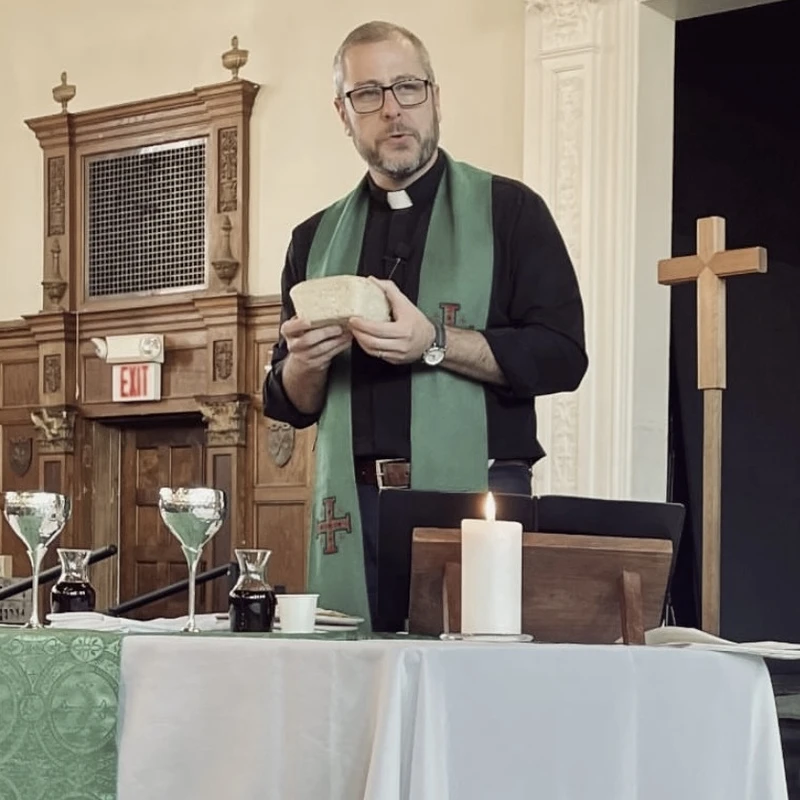
The Lord’s Supper (or Eucharist) provides a fitting image of the shape of Christian mission at Bread of Life. Like the bread for Communion, which members of our congregation bake, we are shaped and kneaded, sometimes through hardship, and leavened with the presence of Christ. We who share the same bread as one body are likewise broken and given “for the life of the world,” as was our Lord (John 6:51). The fundamental Sacrament of Christian life is thus a living image of our mission to enliven the world around us by offering to our communities the real presence of Christ in us through abundant generosity of time and resources and in serving the downcast and downtrodden.

Jesus prayed that his followers would be one, even as he and his Father are one (John 17:11). The apostle Paul likewise urged the early church to be “eager to maintain the unity of the Spirit in the bond of peace” (Ephesians 4:3). Unity is a fundamental fact of the Church, which, as the Nicene Creed says, is “one, holy, catholic, and apostolic.” Yet, as is patently evident, the unity of the church is beset today by many sad divisions. With Christians of goodwill across the globe, we commit ourselves to pray and work for an end to these divisions, for an increase of understanding and agreement about the truth of the Christian faith, and for an enlivening of the spiritual fellowship among all Christians. At Bread of Life, we seek to be a church that celebrates all that is good in the diverse traditions of the Christian faith, while remaining rooted in our Anglican heritage, which we believe helps us in a unique way to embody the ecumenical calling of Jesus and the apostles.

We are part of the Anglican Church in North America and the Global Anglican Communion, the historic network of self-governing, interrelated churches that embrace the orthodox, biblical faith of the English Reformation and its historic forms of catholic church order and liturgical worship. We rejoice that these particularities, far from dividing us from other believers, consistently direct our attention to the central elements of the gospel, what C.S. Lewis called the “mere Christianity” that unites Christians across the globe in love, worship, and obedience to Jesus.